What we inherit
Watch, not poll
A controller no longer asks on a schedule. It opens one relationship and reacts when reality moves.
A single Pod is deleted. The ReplicaSet controller receives it. So does the Deployment controller. So does the garbage collector, the endpoint tracker, the autoscaler. One fact, decoded and remembered again and again, by components that all agree on what it means.
If a hundred components need the same fact, shouldn't it be discovered once?
Somewhere in the cluster a node reclaims a little memory, and a Pod that used to exist no longer does. It is the smallest possible event. Now watch what happens inside the control plane.
The ReplicaSet controller was watching Pods. It receives the deletion. The Deployment controller was watching Pods too. It receives the same deletion. The garbage collector receives it as well. So does the endpoint tracker. So does the autoscaler. So does every other component with reason to keep an eye on Pods.
Each delivery crosses the boundary between source and observer. Each is decoded from bytes into an object. Each observer updates its own private picture of the cluster. They are all reacting to the same fact, and all doing the same preparatory work to learn it.
The watch already taught us not to ask the same question many times. So why are we still answering the same observation many times?
An observer does not just receive events. It reconstructs a current picture of the world from them — the thing controllers actually reason about. Add a second observer, and it wants the very same picture.
This assumes observation belongs to each controller, privately reconstructed every time.
This treats observation as something the system can own once, and controllers merely consume.
A picture of shared reality is shared by nature. Only the effort of maintaining it has been duplicated.
Each controller opens its own watch, reads current state once, follows the stream, and keeps its private picture up to date. This is not a compromise. It is a good design.
Each controller depends on no other. If it crashes, it reopens its watch and carries on. Nothing else needs to know or care.
No shared components, no coordination. When you debug one controller, you never think about another.
It works. A Pod changes, every controller watching Pods is told, each updates its own picture, each decides independently whether the change matters. On a modest cluster, you would see nothing wrong.
Ready: One fact, decoded and remembered once per observer. Run the numbers.
Nothing here is wrong. It is correct at every step. But this book has trained a reflex: when an architecture looks finished and feels effortless, ask what it will cost later — not whether it is correct, but whether its cost is tied to something that will grow.
A handful of controllers, a cluster small enough to fit in memory many times over. Two or three controllers keeping their own copy of a few hundred objects is nothing. At this size, independence is pure profit.
New resource kinds, autoscaling, endpoint tracking, certificate management — every addition follows the rules perfectly.
The shared picture each controller maintains is no longer a few hundred objects. It is tens of thousands — once per controller that cares.
Eleven out of every twelve of those objects exist only because each observer insisted on keeping its own copy.
Nothing has failed. Every controller is still correct. Every watch still works. The system still converges. But the cost of observation now grows with two things at once: the number of controllers that observe, and the size of the world each observes separately.
In the last investigation, polling made cost grow with curiosity instead of change. Independent watching makes cost grow with the number of observers instead of the amount of reality. Same disease. New organ.
We will not break this architecture by finding a bug. There is no bug. We break it the way scale breaks things — by counting.
Twelve controllers watching Pods means one deletion is decoded twelve times. 200 changes/second becomes 2,400 decodes/second — twelve times the work for exactly the same knowledge.
Decoding scales with reality times the size of the crowd.30,000 real Pods become 360,000 Pod objects in memory once twelve controllers each keep their own picture. Every change must then be applied twelve times, not once.
We are treating a shared, read-only fact as if it were private data.A watch is a relationship that stays open. An idle cluster with a hundred observers still requires the source to hold a hundred live channels, fed by nothing, for no new facts.
The source becomes a fan-out machine whose load is dominated by how many are listening.When the source restarts or a connection drops, every observer reconnects and re-reads the entire current state at once — a hundred simultaneous rebuilds hitting a source that just came back to life.
Independent components with a common dependency fail independently, but recover together.Every private picture is late by its own small, independent amount. Twelve observers hold twelve slightly different, momentarily disagreeing versions of one truth.
We are spending twelve times over to get something worse than one honest copy.Ready: Restart the source and watch every independent observer stampede toward the same current state, at the same fragile instant.
Every fault had one root. Observation was private, but reality was shared.
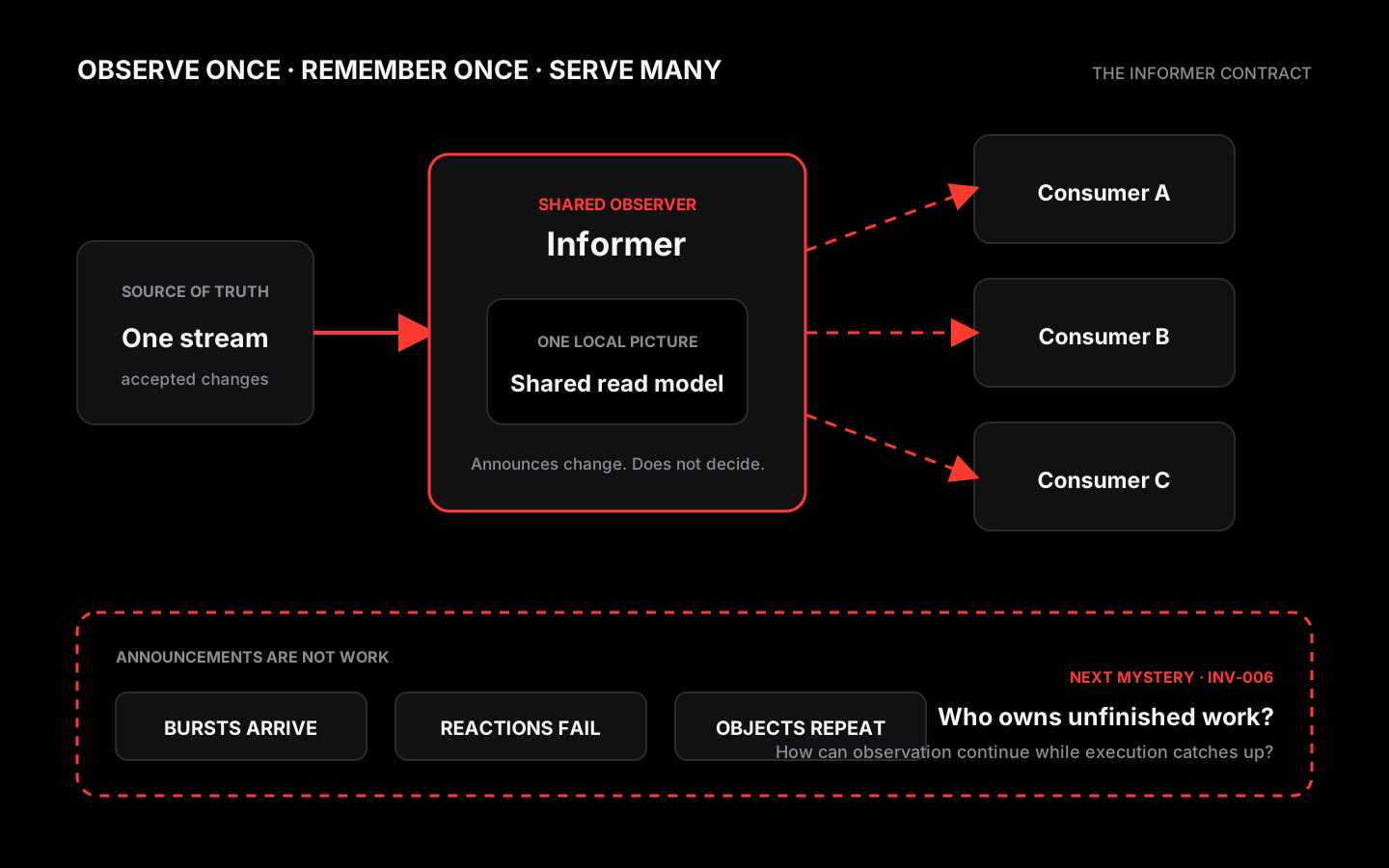
Imagine a single component whose only job is to observe one kind of resource. It opens one watch, reads current state once, follows the stream, and keeps one picture — in one place. It does not decide anything. It does not reconcile. It protects no invariant. Its entire purpose is to know, on behalf of everyone who needs to know.
Walk back through the wreckage and watch it collapse: one decode, one memory footprint, one connection, one recovery, one consistent picture. Every symptom traced to duplicated observation. Removing the duplication removes every symptom at once.
Independent watches: twelve controllers, twelve of everything — connections, decodes, memory, and simultaneous recovery.
One watch, one cache, many consumers. When several controllers share the same Informer for the same resource, Kubernetes calls it a shared informer — the arrangement that actually runs inside a control plane.
Every private picture was late by its own small amount before we shared anything. Sharing observation does not remove lateness. It removes the disagreement between copies of the same lateness.
Ready: Compare what each controller believes about the same deleted Pod.
Reconciliation is level-triggered, so acting on a slightly stale picture delays convergence — it never corrupts it. An Informer is a cache, and a cache is never the territory. That is why a shared, slightly-behind picture is safe: the safety was earned two investigations ago, not invented here.
An Informer observes one kind of resource on behalf of everyone, maintains a single local picture, serves it cheaply, and announces change to everyone who registered interest.
Not one per consumer. The source holds a single channel where it used to hold a dozen.
Kept current from that single stream. This is the shared read model everyone consumes.
A consumer asking "what exists right now?" reads the local picture. Reads become cheap.
Registered consumers are told when to act. Adding a consumer adds no load to the source of truth.
The Informer first reads the complete current state, then follows the change stream and applies each change to its shared picture. If the connection breaks and its previous position cannot be resumed safely, it performs another full read before continuing. The resumable position marker is accepted here as a contract; how that marker is generated and trusted belongs to INV-009.
It does not decide anything — deciding remains the controller's job. It does not promise a perfectly current picture — the local picture is a report, assembled with delay. It does not make the source of truth consistent across failing machines. And it does not manage how a consumer absorbs bursts, retries failures, or de-duplicates repeated notifications — that is about to become our problem.
Shared, read-only knowledge should be observed once and served to many — not rediscovered independently by every consumer. A database serves clients from one maintained copy. An OS keeps one page cache. A CDN observes an origin once. Different domains, the same architecture.
A private watch per consumer is fine when only one or two controllers care about a resource, or when consumers live in genuinely separate processes that should stay decoupled.
Once many controllers, in the same process, would otherwise each open their own watch and hold their own copy of the same objects.
Prediction: Choose one model before running the comparison.
Change arrives in bursts. A rollout touches fifty Pods in a second — can the handler keep up?
Reacting can fail. If a handler fails halfway through reacting to a change, does it get another chance?
The same object changes repeatedly. Must the controller reconcile it three times, or only once, for the latest state?