What we inherit
A shared observation pipeline
Informers, Work Queues, and reconciliation all assumed a single, unambiguous "actual state" waiting to be read.
A ReplicaSet notices a missing Pod. An Informer keeps a cache dozens of controllers trust. A Work Queue remembers a failed reconciliation. Every one of them assumed there was exactly one cluster to read from, and that two controllers asking the same question get the same answer.
What happens the moment more than one machine is responsible for holding that single, shared picture of reality?
"The API Server is returning errors." Every kubectl get hangs. Every controller's watch has gone quiet. The engineer restarts the process. Everything resumes, as if nothing happened.
Then a colleague asks the question that ruins the rest of the night. "Where was the desired state, while the server was down?" — "...On the server." — "The one that was down?" — "...Yes." — "So for four minutes, there was no cluster. There was just an outage, and a very patient set of controllers waiting for someone to pick up the phone again."
"We should run two API Servers," someone finally says. "For availability." It sounds like the obvious fix. It is about to become the beginning of a much longer conversation.
A controller's reconciliation only means something if whoever reads "actual state," and whenever they read it, is reading the same fact. Call this agreement — not a formal consensus algorithm yet, just two readers getting the same answer.
There is only one copy, so there is nothing to disagree with.
It can disappear in exactly one event: one crashed process, one severed cable.
A single machine gives you agreement for free, and durability not at all. Copying that machine's memory onto several machines is the obvious answer to durability. It is not obviously an answer to agreement.
One API Server. One process, on one machine, holding the entire desired and actual state of the cluster in memory. Every controller from every earlier investigation plugs into this without modification.
If Controller A and B ask the same question one millisecond apart, they get the same answer, because they are asking the same memory, not two memories that are supposed to match.
Not "everything degrades." Every controller is, at that instant, unable to observe reality and unable to correct it, because the one place reality lived is gone.
Ready: This is the 2:14 a.m. page, reproduced on demand. Kill the one machine holding the truth.
Identical software, identical configuration, each holding its own copy of cluster state. A load balancer sends each request to whichever one is free.
The team schedules a chaos drill. They kill Server 1 mid-afternoon, on purpose, in front of an audience. kubectl get pods doesn't even hiccup. "We just made the API Server highly available," someone says, "and it cost us almost nothing."
Then a quiet voice near the back asks: "During the drill, was anyone writing to the cluster?" — "...No. We drained traffic first." — "So we tested what happens when nobody writes anything while a server is down."
The chaos drill proved a crash no longer stops the cluster. It did not prove that the two copies agree. Two servers never written to while one is down will look identical — that is silence mistaken for agreement.
The naive architecture survives the failure that started this investigation: one server going down no longer stops the cluster. It does not survive anything else.
A controller scales a Deployment to 5 replicas on Server 1. Milliseconds later, a dashboard controller reads Server 2 and gets 3. Nobody made a mistake — Server 2 simply hasn't heard yet.
For that window, there is no single truth — only two, briefly disagreeing.With 400ms of extra latency, two correct reconciliation loops each see a different replica count and each create three new Pods. Together they create eight Pods where five were desired.
Reconciliation was never designed to protect you from disagreeing about what "actual state" currently is.Two clients scale the same Deployment to 5 and to 2 at nearly the same instant, one request landing on each server. Each server accepts its write honestly, by its own rules.
A system where every member can unilaterally decide something is true has no way to prevent two members deciding two different things.A network split leaves each server healthy, reachable, and correct — from where it's sitting. Each keeps accepting writes from the controllers that can still reach it. Two legitimate histories diverge.
A partitioned server cannot distinguish "I am the only one still working" from "I am the one who got isolated."We solved a single point of failure by adding a second server, and quietly created a second problem we never had: two servers can disagree, and neither is wrong by its own local rules.
Redundancy is not an agreement protocol. It is just more opinions.Ready: Write to one server, then read the other before replication catches up.
Ready: Two clients each scale the same Deployment differently, one request per server. See which one is "wrong."
We do not need more copies. We need exactly one thing: many machines producing one history that all of them can trust.
A distributed control plane does not need multiple copies of the truth. It needs one authoritative history of accepted changes — durable enough to survive any single machine's failure, and agreed upon by more than any single machine's opinion.
This sentence does not say how many machines must agree, or what happens if exactly half are reachable. Those are not omissions. They are the next mystery, and it deserves an investigation that isn't rushed.
Ready: Compare what "history" means with independent copies versus one agreed record.
Not because any one machine is trustworthy alone — but because enough of them agree. How that agreement is actually reached is the next investigation.
Every controller, Informer, and Work Queue from the previous six investigations has been quietly relying on this without it ever being written down.
The cluster's truth is not "whatever this process remembers." It is one authoritative sequence of accepted changes, which may be stored across many machines.
Surviving the loss of a machine must never come at the cost of two machines believing different, incompatible things about the same history.
A write is not "safe" merely because it was copied somewhere. It is safe only after the system has established one accepted outcome before any client is told it succeeded.
It does not say how many machines participate, how they establish one accepted outcome, or what they do while communication is interrupted. It does not promise instant agreement. And it does not eliminate reconciliation: controllers still observe a delayed report, but now that report belongs to one authoritative history rather than a private, competing copy.
You can have durability without agreement — many copies that disagree. You can have agreement without durability — one machine that agrees with itself perfectly, until it disappears. The architecture we're heading toward needs both, simultaneously, on purpose.
For a low-stakes internal tool where an outage is an inconvenience, not an incident, one machine with backups may be entirely appropriate. The failure mode is honest: it is down, or it is up.
Every write that must be agreed upon before it is durable is slower than a write that is merely stored. That latency is not a bug being tolerated — it is the price of the guarantee.
Predict: If the API Server's backing store becomes unreachable, what will kubectl get pods do — hang, error immediately, or return stale data?
Experiment: On a real cluster, block access from the API Server to its storage layer (or stop it), then run kubectl get pods and watch existing controllers.
Observe: Does the API Server serve cached reads, refuse writes, or refuse everything? Do already-running controllers keep reconciling from their last known state?
Reflect: Which of the API Server's behaviors were protecting durability, and which were protecting agreement? Were they ever the same protection?
We now know what we need: one authoritative history, durable across machine failure, agreed upon rather than merely copied. We do not yet know how several independent, fallible machines actually reach that agreement — especially when some of them cannot hear each other at all.
How agreement is reached, what participation it requires, and how disconnected machines rejoin the accepted history remain unanswered.
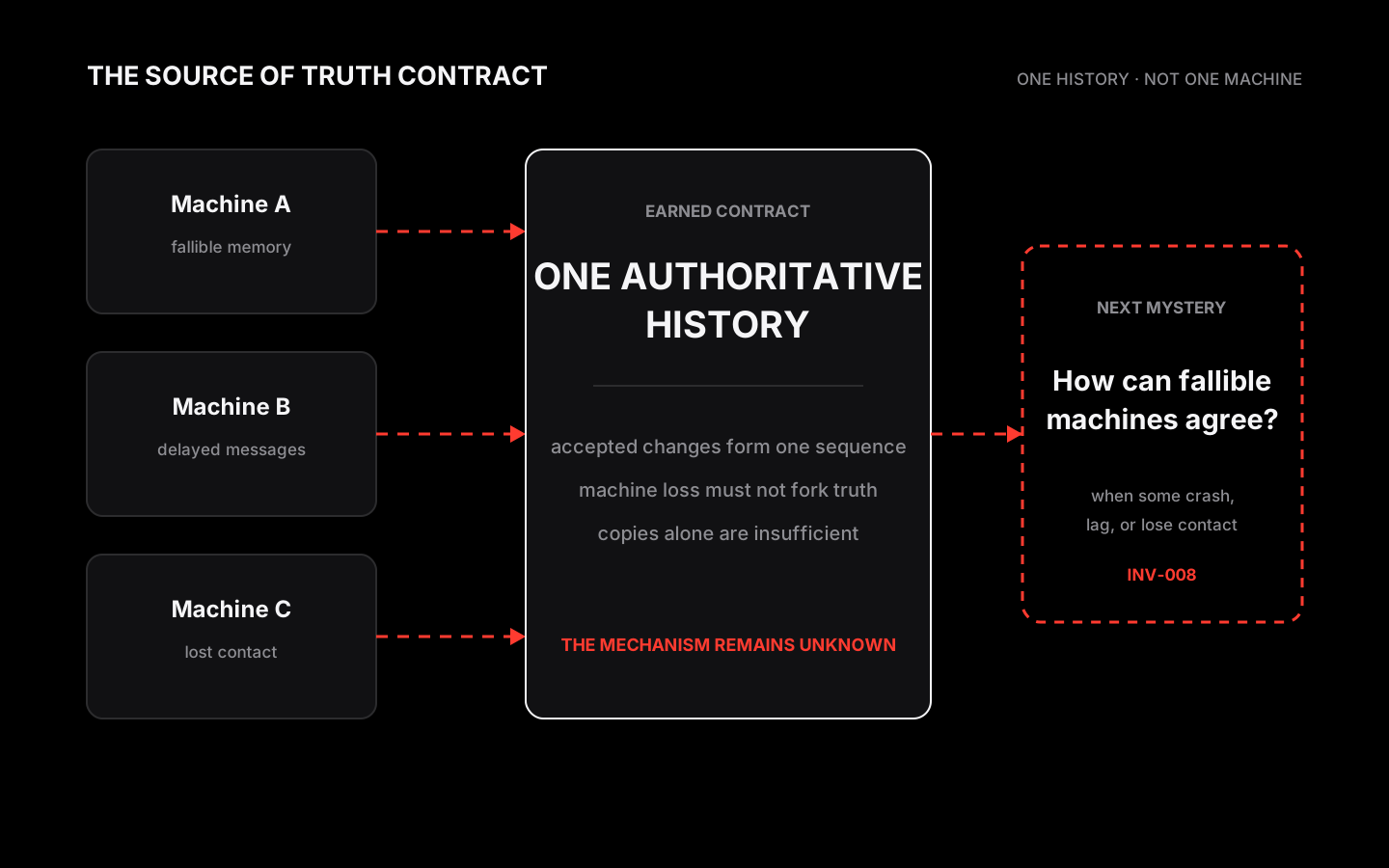
The problem of agreement among fallible, disconnected machines predates Kubernetes. INV-008 will derive that problem on its own terms before naming any particular mechanism.