Stable name
Describes which service the application intends to reach.
Investigation 022 - Cluster Networking Principles
INV-021 gave each service a stable platform-owned address. Applications still use names. When that address changes, who keeps the name connected to current platform state?
Begin the investigation downPrologue
Orders has always called postgres. Yesterday, an operator mapped that name to 10.96.14.27. Today, the platform replaces the service address with 10.96.18.42.
Connect to the same logical service: postgres.
The service now owns 10.96.18.42.
The static entry still says 10.96.14.27.
A valid-looking answer describes yesterday's platform.
First Principles
A name expresses durable application intent. An address expresses current platform location. Resolution connects them without pretending they change together.
Describes which service the application intends to reach.
Describes where the platform currently receives traffic for that service.
A derived observation may lag authoritative state; it is not instantaneous global truth.
Observation is not authority. A resolver answer can be useful while still requiring convergence after change.
Naive Architecture
Operators map each service name to its stable address. Applications read the table and avoid embedding infrastructure addresses directly.
The design adds no continuously operating component.
Applications remain free of direct address configuration.
Few fixed services with rare changes can use this design well.
The Architecture That Almost Worked
Operators update the shared table whenever service state changes, then send that copy to every application group that needs it.
The platform owns authoritative service state. The table has quietly become an independently maintained copy.
Breaking Our Design
Pressure. Platform replaces the postgres service address while a copied mapping remains unchanged.
Prediction. A syntactically valid mapping should still provide a trustworthy answer.
Query, replace address, query untouched copy.
Lookup succeeds with the old valid-looking address.
The copy silently diverges from authority.
A copy cannot detect divergence from itself.
Can updates repair the design?
Detection is not solved here.
Prediction: a valid entry should remain trustworthy.
Pressure. Notifications becomes ready at 10.96.33.18, but application groups hold separate mapping copies.
Prediction. Platform readiness should imply that applications can discover the service.
Deploy once, then distribute independently.
Ready service remains undiscoverable to stale groups.
Two operations lack shared completion.
Readiness does not imply discoverability.
What does distribution cost at scale?
No automation is introduced yet.
Prediction: platform readiness should imply discoverability.
Pressure. Two hundred services are copied into an increasing number of application instances.
Prediction. One service change should remain one small mapping operation.
Scale instances, then change one service.
Facts and update targets grow with copies.
One change becomes participant-wide work.
Cost grows with copies and participants.
Can applications stop owning copies?
No universal threshold is claimed.
Prediction: one service change should remain one small operation.
Pressure. Applications need current answers without owning service state or independently distributed copies.
Prediction. A platform-derived view can converge after authoritative change while remaining honest about observation lag.
Query, change authority, query before refresh, reconcile, query again.
Derived observation can lag, then converge.
Current answer returns after explicit refresh.
Platform owns authority; resolver owns derived view.
Continuously reconcile resolution.
No instant propagation or global truth.
Prediction: a derived view may lag, then converge explicitly.
Optional Episode Review
The Turning Point
The platform remains authoritative for service state. A resolver owns only the continuously reconciled view used to answer names.
The Name Resolution Contract
Whenever names outlive addresses, resolution must continuously derive from the authoritative state that defines current location.
Applications identify services by logical name, not infrastructure address.
The platform owns address resolution; applications do not maintain mappings.
Answers converge from authoritative service state. The resolver owns a derived view, never service truth.
Applications receive answers derived from the same authoritative platform state rather than divergent copies.
Service address changes do not require application configuration changes.
The contract does not require DNS, record formats, caching rules, query transport, or instant propagation.
Only Now: Kubernetes
An application can continue using postgres.default.svc.cluster.local while the platform-owned Service address changes. The observed answer follows the cluster's current Service description through a derived view.
CoreDNS is a common implementation of Kubernetes cluster DNS. It is not the universal architecture, and this investigation does not enter its internals.
The architecture is continuously derived name resolution. DNS and CoreDNS are realizations of that contract.
Engineering Reflection
When identity outlives location, keep the name stable and continuously derive its current location from authority.
A handful of services, rare address changes, and one visible distribution path may justify the simpler design.
Frequent churn and many application instances make copied mappings a coordination burden.
Applications now depend on a resolver capability.
The resolver must observe authoritative service state.
Derived answers converge through non-zero delay.
Every lookup crosses additional platform-owned infrastructure.
No. The experiment exposes how cost grows with participants. The acceptable threshold is policy and context, not universal architecture.
No. It is a derived observation. Correctness requires explicit convergence from authoritative state, not a claim of instantaneous propagation.
Investigation Exercise
Predict what each application observes when only half receive a changed mapping.
Trace one authoritative address change across one hundred copied mappings.
Separate authoritative state, stale evidence, and current derived evidence.
Identify who should own service state and who should own its derived view.
Bridge to INV-023
Service names remain stable while addresses change.
Applications no longer maintain copies of platform knowledge.
The resolver continuously derives a view from authoritative service state.
But a browser knows nothing about internal names or virtual addresses.
A public request arrives at the platform boundary asking for entry.
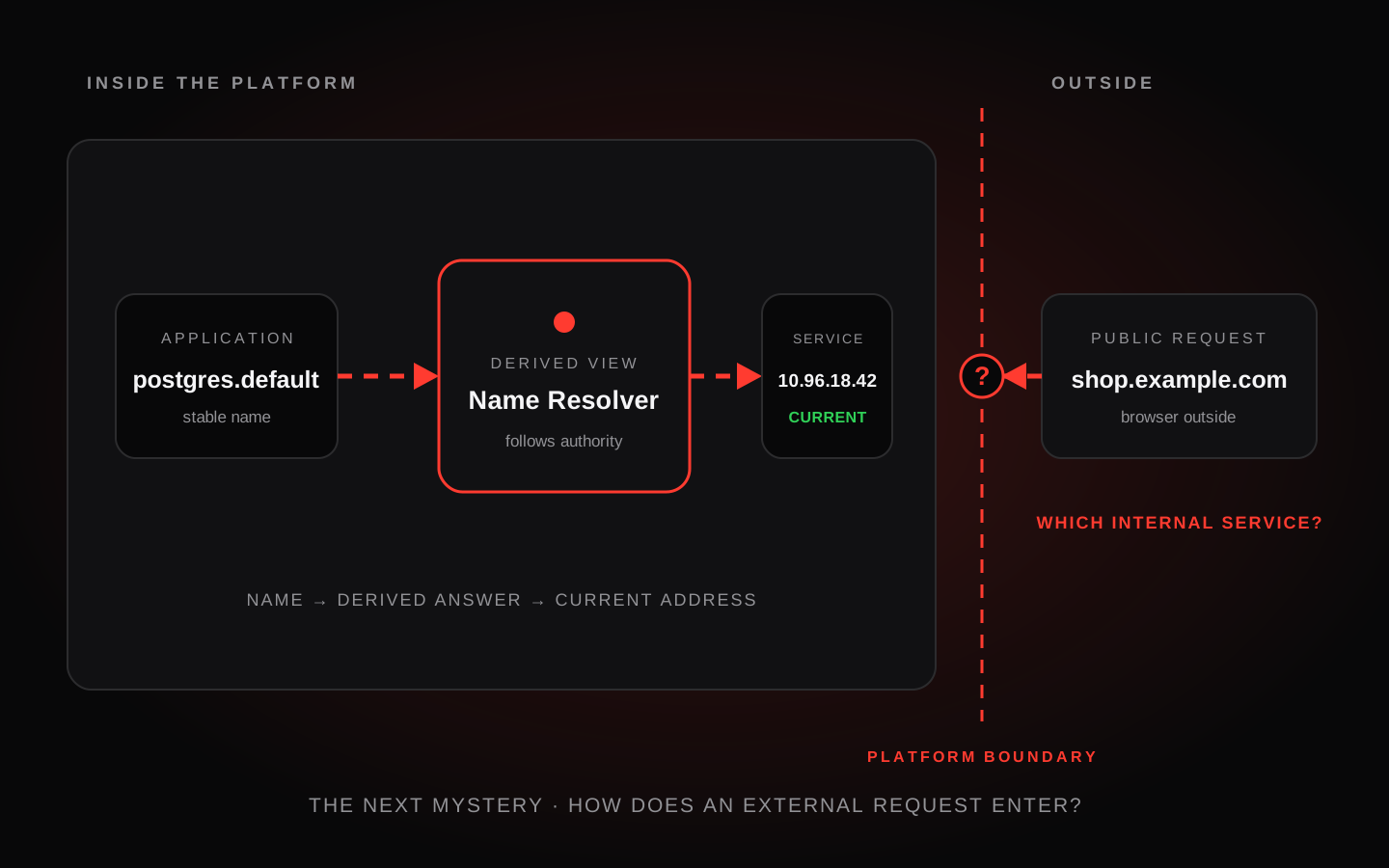
Name resolution discovers where a service exists inside the platform. External access asks how a request enters it.
This investigation inherits the feedback-loop and reconciliation model from control theory, together with platform precedent from Borg and Omega. It applies that inherited lineage to a resolver-owned derived view; it does not claim that Borg or Omega introduced cluster DNS.