Temporary
A Pod may be created, destroyed, and replaced.
Investigation 025 - Persistent State Principles
The platform is correct to treat execution as disposable. A database is valuable precisely because its information is not.
Begin the investigation downPrologue
A stateless server disappears and a replacement continues. A database returns without the history that made it useful.
The platform replaces missing execution.
Replacement has no lasting consequence.
The workload accumulates irreplaceable information.
How can data outlive disposable execution?
First Principles
Moving bytes from memory into files changes durability only when those files belong to something with a longer lifecycle.
A Pod may be created, destroyed, and replaced.
Required lifetime comes from meaning, not the current process.
Different lifetimes require independently governed resources.
Naive Architecture
For stateless work, starting another instance restores correctness because no valuable local history must survive.
The Architecture That Almost Worked
Records are visible in the container's writable layer. The medium changed; the owner did not.
Breaking Our Design
Each experiment begins clean and stops before the next episode's answer.
Pressure. A database stores records in its execution-owned writable layer.
Prediction. Files should survive because they are not only in memory.
Write, inspect, replace, inspect.
The replacement layer is empty.
Files inherited execution ownership.
Medium did not change lifetime.
Find a longer-lived owner.
No node or volume solution yet.
Pressure. Records live on Node A's local disk.
Prediction. Surviving process replacement should mean surviving rescheduling.
Replace locally, suspect A, schedule on B.
Local recovery works; B lacks access.
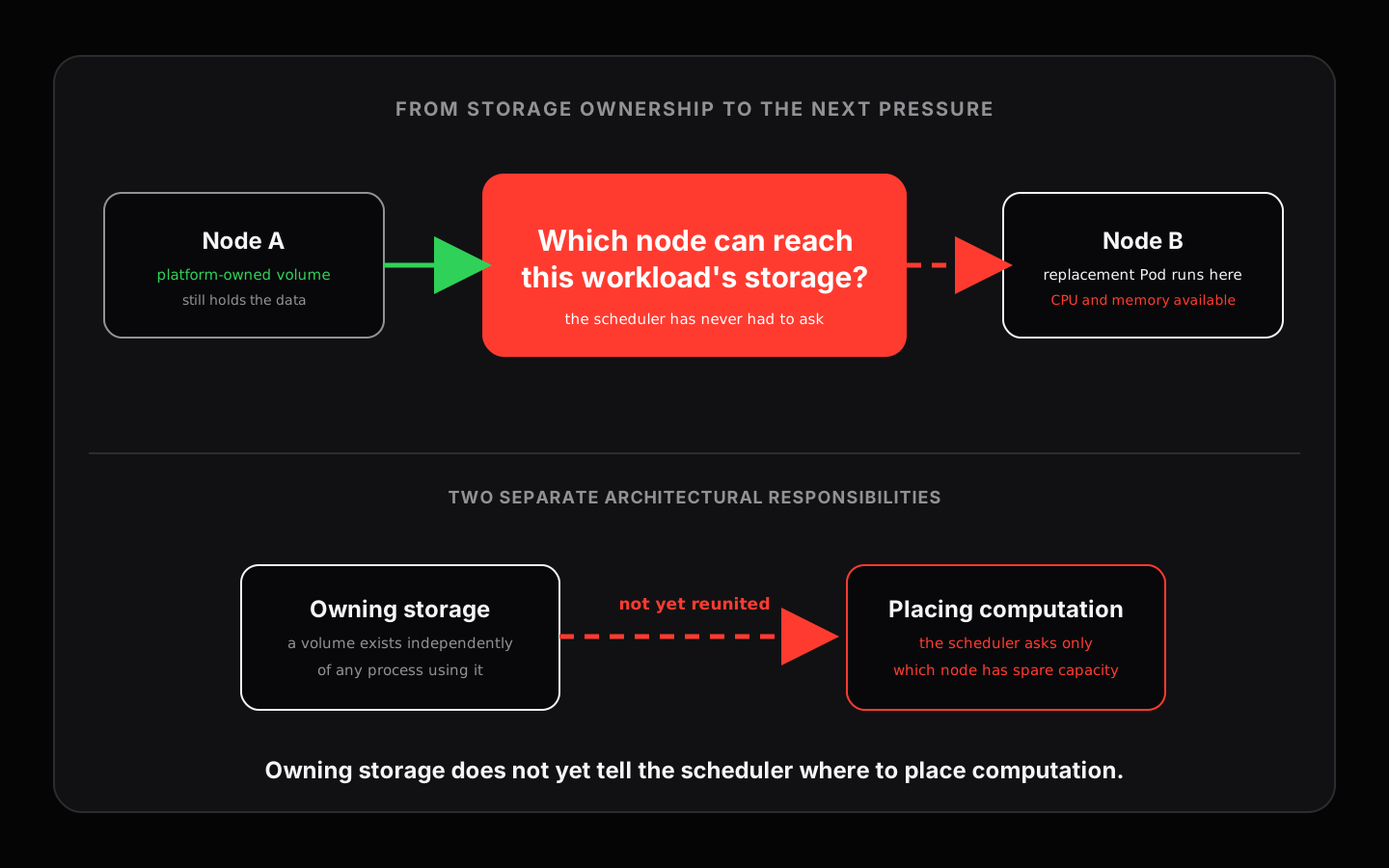
Compute and data location diverge.
Node-local state inherits node constraints.
Own a longer lifecycle.
Topology waits for INV-026.
Pressure. Four applications each provision, attach, and reclaim storage.
Prediction. Independent ownership should preserve a consistent platform environment.
Assign 3 duties to 4 apps.
12 assignments diverge.
Collision, orphan, readiness gap.
Platform owns lifecycle.
Resource precedes and outlives execution.
No universal attachment claim.
The Turning Point
The Persistent Storage Contract
Execution remains replaceable because persistent storage has an independently owned lifecycle.
Execution start and stop do not implicitly create or destroy logical storage.
Replacing computation must not become data destruction.
Across rescheduling, storage remains the same logical resource. This is an architectural declaration, not proof: topology, partitions, partial failures, and concurrent writes constrain implementation and remain deferred.
The platform owns provisioning, attachment, and reclamation.
Execution may change without redefining persistent information's lifecycle.
Responsibility is assigned without promising physical durability under every failure.
Only Now: Kubernetes
A PersistentVolume represents cluster storage with a lifecycle independent of a Pod. A PersistentVolumeClaim is a workload's request for storage. The application expresses need; the platform owns lifecycle work.
This differs from the ordinary ephemeral container writable filesystem. A PV does not mean its backend can never fail or that it survives backend destruction or every deletion policy.
StorageClass, topology, and delayed binding belong to INV-026; CSI to INV-027; StatefulSet and stable identity to INV-028. Syntax, phases, access modes, and reclaim policy remain outside this investigation.
Engineering Reflection
Resources with different required lifetimes need independent ownership.
When another authority can reproduce every needed byte, persistence may add cost without protecting value.
When correctness depends on accumulated state, disposable ownership is unacceptable.
Storage must exist before use.
Attachment and reclamation need ownership.
Location constrains execution.
Slow, unreachable, and failed are different.
Investigation Exercise
Predict availability after replacement and rescheduling.
Compare Pod, node, application, and platform ownership.
Separate physical existence from accessibility.
Identify the bounded contract earned.
Bridge to INV-026
The Pod no longer owns its records.
The platform owns provisioning, attachment, and reclamation.
The logical resource remains after execution stops.
Physical storage remains subject to infrastructure constraints.
Compute placement and storage topology now collide.
This investigation inherits reconciliation and independent ownership from control theory and the architectural lineage of Borg and Omega. It does not claim they introduced Kubernetes persistent-volume APIs.