Ordinary configuration
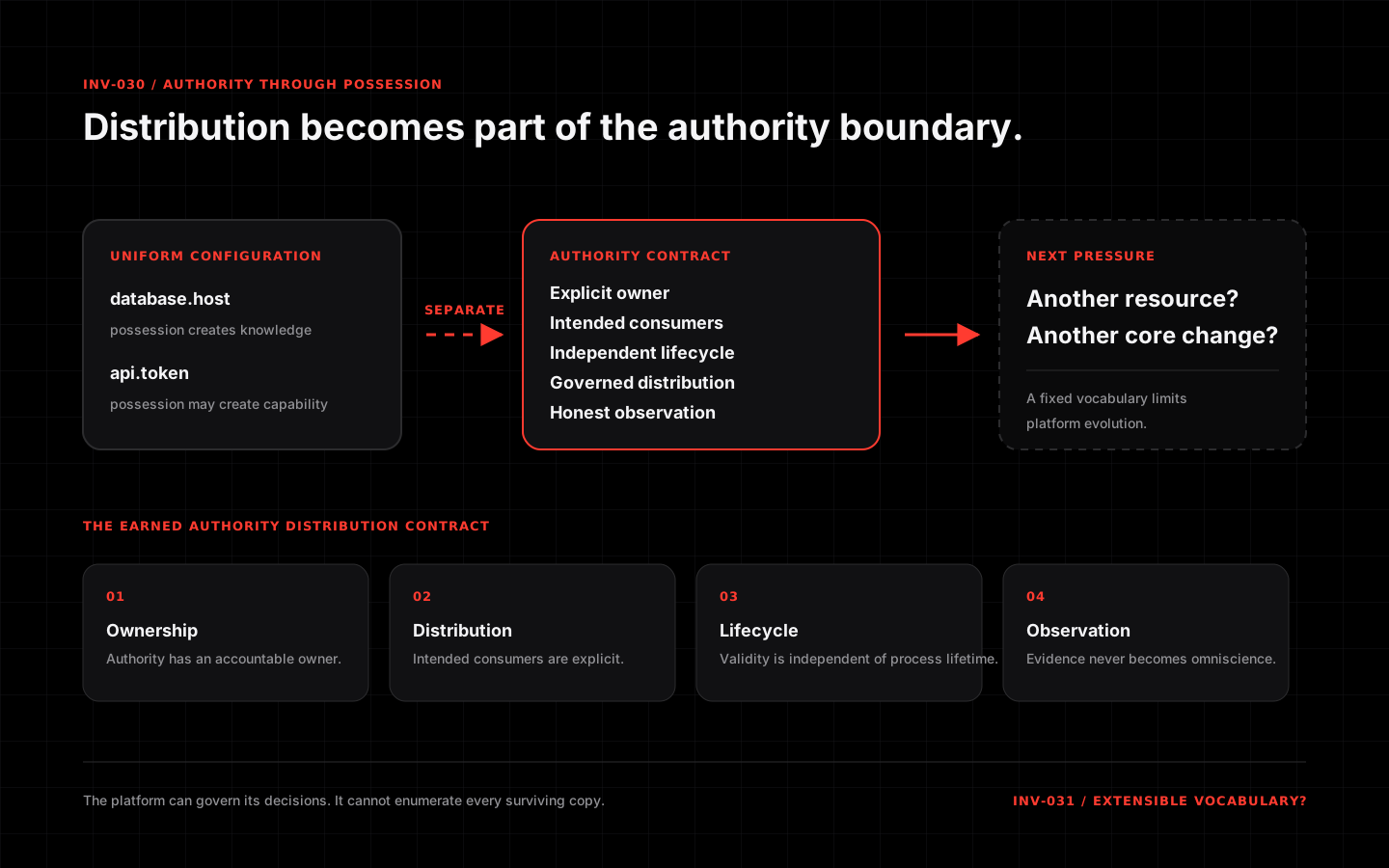
Knowing a database address gives an actor knowledge about the environment. It does not, by itself, authorize the actor to use the database.
Investigation 030 - Platform Evolution Principles
INV-029 let the platform distribute ordinary operational intent independently of executable logic. One of those values is not merely information. Possessing it may let the holder act.
Begin the investigation downPrologue
An application needs a database address, a timeout, and a credential at runtime. All three are values the platform can supply without rebuilding the executable. The obvious design sends all three through the same configuration path.
Operational intent already moves through the platform independently of executable logic.
Every runtime value can share one ownership model, one visibility boundary, one distribution path, one lifecycle.
One of those values is a credential. Its holder may be able to authenticate, decrypt, or sign — not merely learn something about the environment.
If nothing about the configuration contract has technically failed, what has the platform not yet distinguished?
First Principles
Two runtime values can look identical to an executable — both strings, both read at startup, both supplied from outside. What differs is the consequence of possession, not the byte layout. Observing that a value was distributed is not the same claim as knowing it was consumed, used, or possessed by only its intended holder.
Knowing a database address gives an actor knowledge about the environment. It does not, by itself, authorize the actor to use the database.
If the receiving system accepts a token as evidence of authority, possessing that token may let the holder exercise it.
Information that is only harmful when disclosed is a related problem. It does not define the authority-lifecycle contract this investigation derives.
Possession of the value may itself be sufficient to exercise a capability.
Naive Architecture
The platform already knows how to store and distribute operational intent. A hostname, a feature flag, and a credential are all inputs a process reads at startup. The simplest architecture treats them identically: one ownership model, one visibility boundary, one distribution path, one lifecycle.
The Architecture That Almost Worked
While the platform serves a small number of trusted operators, and the consumers of each value are known in advance, one configuration contract is a genuine engineering advantage. Every additional distinction would be another interface to operate.
Operational intent still moves independently of executable logic, through one familiar path operators already understand.
Every reader of the configuration surface is already trusted with everything on it, including whatever grants authority.
The architecture strains only as the trust boundary around that surface begins to grow.
Breaking Our Design
Each experiment starts from its own clean state and stops at its assigned discovery. None of them reaches for encryption, authorization policy, or a delivery mechanism as the answer.
Pressure. The platform grows. A diagnostic reader is granted access to a shared configuration surface that also holds a credential.
Prediction. If the reader is already trusted to diagnose the application, seeing everything on that surface should be harmless.
Establish ordinary configuration and a credential on one shared surface, then grant a diagnostic reader access to that surface.
Revealing the surface to the reader reveals the credential exactly as it reveals the database address.
Ordinary visibility silently decided who could possess authority — the platform never made that a separate decision.
Every extra reader may become a potential actor. Ordinary configuration visibility cannot silently define authority possession.
Suppose distribution is narrowed to the one consumer that needs the credential. Does that govern what happens next?
Copying after legitimate delivery is not tested here.
Prediction: if the reader is already trusted, seeing everything should be harmless. Establish the shared surface to test it.
Pressure. Process A is the intended consumer of a credential. The platform delivers exactly what it intended to deliver.
Prediction. If distribution was restricted to the correct consumer, the platform's distribution decision should govern the credential from then on.
Deliver the credential to Process A, let Process A create a second representation outside the platform's distribution surface, then inspect the boundary.
The platform's distribution record still shows exactly one intended delivery. A second representation now exists that the platform never distributed.
The platform's control ends at the boundary of its own distribution decision, not at every representation the consumer later creates.
Initial distribution control is not downstream copy control. Intended delivery is legitimate; it does not prove or govern later copies.
Suppose no unintended copy is ever created. Does the credential remain meaningful for as long as Process A exists?
What happens when the consumer itself disappears is not tested here.
Prediction: the platform's distribution decision should govern the credential from here on. Let Process A create a second representation to test it.
Pressure. Process A is the sole intended consumer of a credential, and the credential is valid. No unexpected copy exists.
Prediction. Removing the only intended consumer should be enough to end the authority it was using.
Remove Process A, then test the credential's external validity, then optionally introduce a replacement credential.
Process A is gone. The credential is still accepted by the external system that recognizes it.
Ending the consumer's execution did not end the authority the platform distributed to it.
Consumer lifecycle is not authority lifecycle. Platform resource lifecycle is not external validity. Authority needs independently governed responsibility.
If the platform now governs that responsibility, does it also know who currently holds every copy?
Choosing a duration, rotation cadence, or revocation mechanism is not tested here.
Prediction: removing the only intended consumer should end the authority. Remove Process A to test it.
Pressure. The platform already knows the owner, the intended consumer, and its own prior distribution decision for a credential.
Prediction. With owner, consumer, and decision all known, the platform should be able to account for every copy of the credential.
Create a possible copy, remove the consumer, record the platform-visible activity, then attempt a full inventory of holders.
The platform can list its owner, its intended consumer, its distribution decision, and the activity visible at its own boundary. It cannot list every surviving copy.
The inventory attempt stalls at the platform's own boundary. Nothing beyond that boundary is observable from inside it.
The platform can know its owner, intended consumers, its own decisions, and platform-visible activity — it cannot establish successful consumption, every surviving copy, transfer, an offline holder, or global present possession.
What contract can the platform honestly make given this boundary? Chapter 07 formalizes the answer once all four experiments are complete.
The final contract is not formalized inside this episode.
Prediction: with owner, consumer, and decision known, a full inventory should be possible. Create a possible copy to test it.
The Turning Point
Four failures point at two responsibilities. Chapter 07 must separate ownership of authority from governance of platform distribution.
The Authority Distribution Contract
Authority-bearing material must have an explicit owner, explicitly defined intended consumers, and a lifecycle independent of the executable that consumes it. The authority owner governs continued existence and external validity; the platform governs its distribution decisions and keeps visible failures distinct from completion without claiming global present possession of every copy.
Someone must be accountable for why the authority exists and when it should change.
Who should receive the authority must be a stated boundary, not an inference from who happens to need it.
Authority must not implicitly end or begin only because the executable that consumes it does.
The platform must be able to represent who is intended to receive authority and who is not.
Ending or replacing authority must not require rebuilding the executable logic that consumes it.
A replacement decision and a completed transition are different states; failures visible within the platform boundary must not be mistaken for success.
Platform-visible distribution activity is not the same claim as successful consumption or global present possession.
Resource lifecycle, distribution lifecycle, and external authority lifecycle are three separate timelines. The platform may coordinate them. It must never collapse them into one.
Only Now: Kubernetes
Kubernetes provides the Secret API object for a small amount of sensitive data such as passwords, tokens, and keys, deliberately separated from ConfigMap, which is intended for non-confidential configuration. A Pod references or selects a Secret as the platform's intended distribution path, and the Secret's own lifecycle is independent of any one Pod that reads it.
Kubernetes auditing can record API activity and request metadata when configured with an appropriate policy and backend. At the normal Metadata audit level, request and response bodies are not necessarily logged, and an audit record does not by itself prove that an application successfully consumed or used the Secret's data. Deleting or updating a Secret changes the Kubernetes resource; it does not, by itself, invalidate an external credential that recognizes it, nor does it guarantee that every previously delivered copy has stopped being valid.
Base64 encoding is not encryption — it is a reversible representation, not a protection mechanism. Kubernetes Secrets are stored unencrypted by default unless the cluster is explicitly configured with encryption at rest, and least-privilege access to Secret data is recommended precisely because visibility of the resource is not the same as authorization to use what it contains.
A distinct resource for sensitive data, not a flag on ordinary configuration.
A Pod selects the Secret it needs; the platform does not treat every actor as an equally intended consumer.
API activity can be recorded; consumption and global possession remain unproven.
None of this turns encryption, authorization policy, or rotation into part of this investigation's contract. It shows where Kubernetes realizes the contract we derived, and where the realization remains honestly partial.
Engineering Reflection
When possession of information creates capability, distributing that information is itself an authority decision — not merely a delivery problem.
Few operators, few consumers, strong trust, low-consequence credentials: a separate authority contract adds cost this system does not yet need to pay.
Independent teams, unequal trust boundaries, and credentials that outlive their consumers: ordinary configuration visibility is no longer a defensible boundary.
Someone must be accountable for the authority itself, not merely for consuming it.
Intended consumers, lifecycle decisions, and distribution activity must be retained and maintained.
Authority distribution can now fail independently of application execution.
The architecture gains no omniscience — it can observe its own boundary and nothing beyond it.
Investigation Exercise
Compare database.host and api.token distributed through exactly the same contract. Predict who may need each value, what happens if each is copied, what happens if the consumer disappears, and what the platform can know about surviving copies.
Trace one consumer through delivery, an additional copy, removal, and a replacement consumer, noting what the platform recorded at each step.
Notice that what the platform intended, what it observed, and what may actually exist are three different states — not one.
Ask what an owner must decide about authority that an executable's own lifecycle can never decide for it.
Bridge to INV-031
The platform no longer treats every runtime value as interchangeable configuration.
Authority-bearing material now has an explicit owner and explicitly defined intended consumers.
Its lifecycle is independent of the executable that consumes it, and its distribution is governable.
Kubernetes Secret realizes this contract partially — as a separate resource, consumer-scoped, and honestly bounded in what it can observe.
But representing authority required a new kind of resource. What happens when the next problem needs a resource the platform does not yet understand?
This investigation inherits explicit ownership, bounded responsibility, and honest observation from earlier investigations. Its authority-lifecycle lineage is grounded in security engineering that treats credentials and key material as assets with owners, intended uses, distribution boundaries, and lifecycles. Kubernetes Secret is one partial realization of that broader contract; this investigation does not claim that Secret governs every copy or owns the external authority represented by its data.