Foundation
The platform already knows how to validate structure — INV-031 established that a well-formed proposal can be recognized and advanced toward the authoritative write boundary.
“A boundary that only records what crosses it has not yet decided what may cross it.”
The database team proposes
ReplicatedDatabase orders-production with
replicas = 3. Every structural check succeeds — the
platform understands the proposal perfectly. The production
reliability team's rule requires at least five replicas for a
production database. Both conclusions are true.
The platform already knows how to validate structure — INV-031 established that a well-formed proposal can be recognized and advanced toward the authoritative write boundary.
If the proposal is structurally valid, nothing else should need to stand between it and authoritative state.
The reliability team's rule requires at least five replicas. The proposal requests three. The platform's approval and the rule's refusal are both true at once.
orders-production resource exists yet.
Mystery: who may decide whether a proposal the platform understands is allowed to become a fact the platform must preserve?
The prologue produced two truthful statements about one proposal: the platform can represent it, and the production rule does not permit it. Untangling accept requires separating what can be represented from what is permitted, from what exact state was judged, from who judges it, and from who may change the authoritative record.
Can the platform represent the proposal under its declared shape? INV-031 already answered this.
Do the relevant organizational rules permit it? An independent claim from structure.
What exact proposed state was evaluated — C0, not
whatever it becomes next?
Who judges the rule? Owning a judgment does not grant ownership of authoritative history.
Who performs the one transition from the current authoritative version to the next?
The same request path checks structural conformance, applies
organizational rules, and writes accepted state. Structure runs first
— a reliability rule should not have to interpret a malformed
replicas field — then the reliability, security, and
finance rules the platform team also owns, then the inherited version
check and commit. One owner, one release train, and a small rule set
make this coherent.
Aligned ownership keeps policy, implementation, release, and operational consequences in one understandable boundary.
No candidate becomes authoritative while a required check remains unfinished.
Every rule will continue to change for the same reasons and on the same schedule as the platform.
Only the production replica rule moves. The platform still checks
structure, still owns the inherited version check and write, but
presents a bounded decision request — resource kind, name,
environment, proposed fields — and expects back only
permit or refuse with a reason. The
participant never touches the platform's private object model.
The rule owner can change its implementation without changing platform source, but the participant still ships on the platform-managed release train. The correctness-critical write path also waits synchronously on that participant.
Everything else stays put. Structural checks, the inherited version check, and the authoritative write remain exactly where they were — only the production replica rule moves.
A bounded request is enough independence. The reliability team can change its rule behind a public boundary. We have not yet tested who must control its release when platform and rule-owner conditions diverge, or what happens when it is slow, silent, or judging a candidate that has since changed.
Implementation ownership moved. Release ownership and write-path dependence did not.
Episode 01 begins from the almost-working design. Each later pressure unlocks only after the preceding discovery creates its reason to exist, while every experiment keeps independently resettable state.
Can the security team change its registry rule while the platform release remains frozen?
Establish the shared release boundary.
What happens when one separately operated participant delays a high-volume synchronous path?
Establish request volume before delaying a participant.
Does an unchanged candidate keep a truthful decision current when its supporting evidence changes?
Present C0 to the release participant.
What can the platform truthfully infer when a required ownership result never arrives?
Require an ownership judgment.
Can a permission for C0 authorize C1 after another participant transforms the proposal?
Present C0 before collecting candidate-bound results.
The five failures did not describe five unrelated bugs. They exposed the conditions a pre-commit boundary must preserve: independent release cadence, synchronous write-path dependence, observation age, explicit disposition instead of silence, and results that never outlive the exact candidate they judged.
The platform needs independently owned judgments before commit, but it cannot delegate the meaning of candidate identity, the composition of results, or the transition into authoritative state. Eight obligations hold that boundary together.
Proposed state remains non-authoritative throughout evaluation and transformation.
Participants receive bounded candidate data and declared context, not private platform internals.
Every result applies only to the exact candidate and bounded evidence evaluated.
Every required participation reaches a declared outcome before commit. Silence decides nothing.
The platform deterministically combines transformations and decisions.
Structure and every required final-state disposition apply to the candidate actually committed.
The platform performs one inherited version-checked authoritative commit, or none.
Participant side effects are not atomic with the authoritative platform commit.
Candidate, decision, and authority remain three separate things. The architecture must never let one silently stand in for another.
The API server owns the request path and authoritative write. Built-in admission controllers and independently operated admission webhooks contribute bounded mutation or validation results without becoming authoritative writers. Mutating admission runs first and may transform the candidate; validating admission then judges the resulting candidate — mirroring the composition-then-final-validation sequence this investigation derived.
Mutating webhooks may transform the candidate before validation runs.
Validating webhooks and built-in controllers judge the resulting candidate; none becomes an authoritative writer.
failurePolicy (Fail or Ignore) turns an invocation
failure into a declared outcome instead of silent uncertainty.
failurePolicy realizes a chosen disposition; it does not
explain why a participant did not answer. This does not cover
authentication, RBAC authorization, or which specific organizational
rules should exist — those are separate mechanisms this investigation
does not decide.
Keeping every rule inside the platform core remains the better architecture when one team owns the platform and its rules, release lifecycles stay aligned, the rule set is small and candidate-local, and one operational boundary is genuinely preferable to several. Independent participation is not free: it adds latency, availability risk, and operational surface that must be justified by rule owners whose reasons for change have already diverged from the platform's own.
Required evaluation adds synchronous work before commit.
An independent participant can delay or prevent completion.
Transformations can invalidate earlier final-state judgments.
The authority owner must preserve deterministic candidate semantics.
Independent participants must be deployed, observed, and recovered.
Incomplete required dispositions produce no authoritative transition.
These costs are accepted only when independent rule ownership is worth more than one synchronous, tightly coupled request path.
Track one proposal through mutation, judgment, and commit. Label every candidate it becomes, every participant that judges it, and the single authority that performs the final transition.
Does A's permission for C0 authorize C1 after B transforms it?
Label each candidate, transformation, judgment, and authority transition.
A's truthful C0 result has no authority over C1.
Identify who composes, validates, and commits the final candidate.
The proposal crossed one governed authority boundary.
The accepted desired state is now authoritative.
INV-014 already established correctness filtering and placement.
Feasible choices can still have different economic consequences.
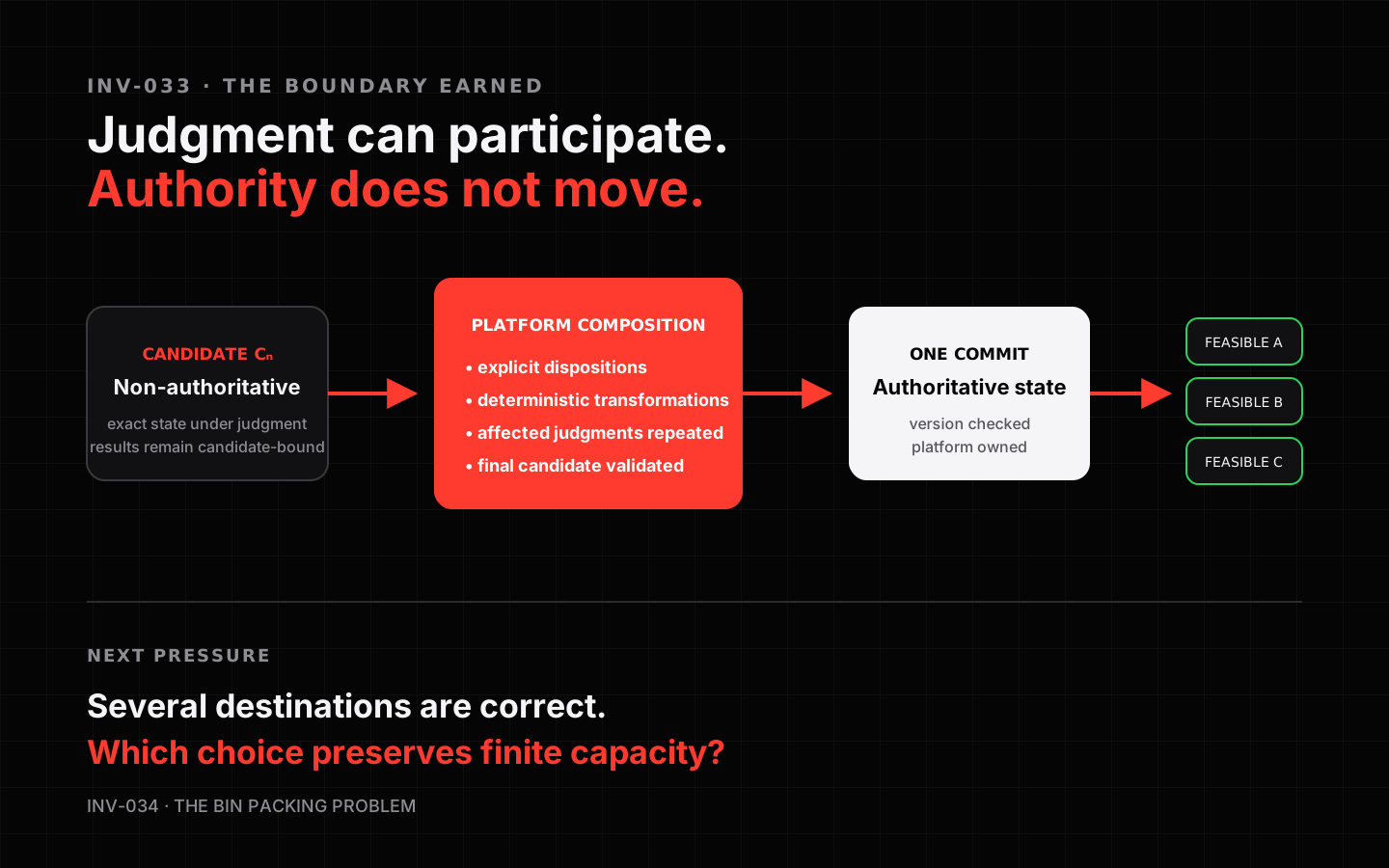
How should feasible placements be compared without treating economic preference as truth?
Correct placement is not yet economical placement.
This investigation inherits the authoritative history and concurrency contract from INV-007 and INV-009, and the extensible resource and automation boundaries from INV-031 and INV-032. Separating a correctness-critical decision from the party who owns it is a long-standing distributed-systems pattern: participants may judge or object to a proposed transition while one authority retains responsibility for the commit. Kubernetes admission control is one realization of the broader Request Admission Contract derived here; this investigation does not claim that admission control invented candidate-bound, pre-commit judgment.