Inherited
Unfinished work remains owned after failure; observation is delayed and partial; a preference needs an explicit objective.
Investigation 039 - Distributed Systems Economics
An unfinished correction remains legitimate after a failed attempt. Trying again consumes finite shared execution capacity. Ownership does not grant unlimited access to that capacity. What economic authority may govern another attempt?
Unfinished correction
Still ownedLegitimate to retry. Free to retry now — not yet.
Prologue
Something has failed. The responsibility has not necessarily disappeared, so another attempt may still be necessary. But that attempt consumes a finite, shared pool that other legitimate work also needs. Restricting effort raises its own question: does withholding an attempt change the underlying responsibility, or only the present opportunity to spend capacity on it?
Unfinished work remains owned after failure; observation is delayed and partial; a preference needs an explicit objective.
Give every item the same bounded allowance and call the system protected.
How can ownership survive without granting unlimited access to finite corrective effort?
First Principles
Unfinished work can outlive many attempts. A retry is another attempt, not another piece of ownership.
Worker time, network, dependency processing, and coordination are all finite and shared.
An economic decision about effort is not automatically a decision about the work's status.
What the system observed, concluded, and decided are three different things that can drift apart.
Unfinished work, eligibility for another attempt, selection for execution, an attempt in progress, and success are five different states.
Naive Architecture
When an attempt fails, execute another immediately. No allowance, no waiting period, no economic calculation. The responsibility never silently disappears, and for rare, cheap, quickly-recovering failures this is often sufficient.
The Architecture That Almost Worked
An unfinished item may attempt repeatedly, but only until its allowance for the current interval is exhausted. The work is not deleted when the allowance runs out — it simply waits until the next interval. One item's effort is now bounded.
One unfinished item cannot consume unlimited corrective effort within the accounting interval. That is all this candidate establishes.
Breaking Our Design
Episode 01 starts from the per-item allowance candidate. Each later episode unlocks only after the preceding discovery creates its boundary.
One item stays within its allowance but consumes it in a concentrated burst rather than spread across the interval.
Run the same allowance spread across the interval first.
Every item independently respects its allowance, but the population keeps growing.
Grow the population while every item stays individually compliant.
Shared capacity is finite and demand exceeds it. Some legitimate work is not selected for the current attempt.
Evaluate demand against finite shared capacity.
An economic decision was reasonable given its evidence. The evidence has since changed.
Make an economic decision from today's evidence.
The Turning Point
The Retry Economy Contract
Economic authority may constrain present access to finite corrective execution capacity. It must remain explicitly scoped, and it must never silently become a lifecycle decision.
A cumulative allowance over an interval does not, by itself, bound how concentrated that effort is.
Independent per-item bounds need an explicit accounting domain before they support a system-wide claim.
Not receiving a present execution opportunity does not complete, cancel, or release durable ownership.
A future-effort decision must not silently become permanent exclusion once its supporting evidence changes.
Ownership is not unlimited access to effort. Economic authority is not lifecycle authority. A past decision is not permanent authority.
Only Now: Kubernetes
A delaying queue can make a remembered item eligible again after a chosen duration instead of immediately. A rate-limiting queue asks a configured limiter when an item may be added again and tracks how many times it has been requeued. The default typed limiter combines a per-item policy with an overall token-bucket policy — making the per-item-versus-aggregate distinction concrete.
Calling Forget clears an item's retry history. It
does not, by itself, prove that desired and observed state agree
or that the underlying responsibility is resolved — the
controller still owns that lifecycle judgment.
Client-go illustrates the contract through one family of mechanisms. It does not define the contract for every corrective system.
Engineering Reflection
Failures are rare, attempts are cheap, dependencies recover quickly, and little unrelated work competes for the same capacity.
Persistent failures, large subject populations, or shared dependencies make retry effort a material cost.
Protecting finite capacity means not every unfinished item gets an immediate attempt.
Aggregate claims need a defined subject and accounting domain, not an assumed one.
Preserved ownership does not prove that work will eventually execute or succeed.
An economic decision cannot be treated as timeless just because it still exists.
Investigation Exercise
State whether one item's allowance bounds contention, and whether nonselection changes ownership.
Vary concentration, population size, available capacity, and supporting evidence while holding the allowance fixed.
Record whether an old economic decision keeps claiming authority after its evidence has changed.
Separate the architectural boundary from the interval, curve, or quota a concrete system chooses.
Bridge from Movement VI
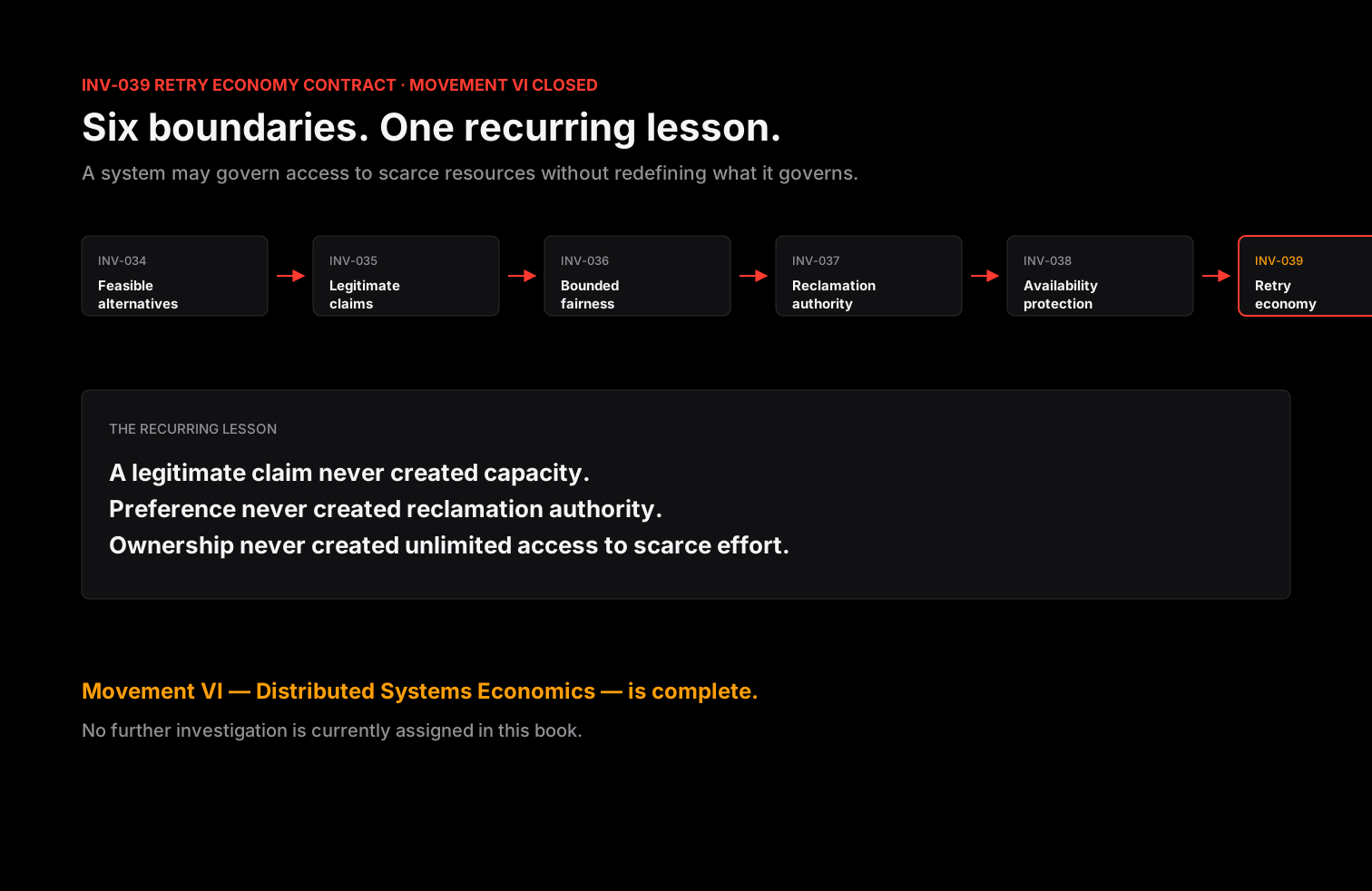
A system may govern access to scarce resources without allowing that economic decision to redefine the responsibility, authority, or evidence on which correctness depends.
Borg made finite shared resources, isolation, and large workload populations explicit operational concerns. Omega showed that individually legitimate decisions can interfere over shared state. Control theory separates the persistence of an error signal from the policy and actuation used to influence it. Kubernetes client-go realizes these ideas through queues that remember work and limiters that govern when another attempt becomes eligible.