Inherited
Claims are legitimate, capacity is finite, and unavailable revisions remain non-authoritative.
Investigation 036 - Distributed Systems Economics
Three independently owned capacity-change claims each fit alone. Together they do not. Correctness can reject the incompatible state. What must allocation make explicit before its treatment can be defended as fair?
Available compatible capacity
12 units24 requested / 12 available
Prologue
A, B, and C each seek eight units from a pool containing twelve. Every claim is legitimate. No rule of correctness says which owner should wait or receive less. The missing decision concerns treatment among legitimate participants.
Claims are legitimate, capacity is finite, and unavailable revisions remain non-authoritative.
Apply the same arithmetic to every claim and call the result fair.
Which comparison makes that claim meaningful and defensible?
First Principles
Which legitimate identities count as comparable economic participants?
Which established subjects compete in the same scarcity decision?
Does the claim concern owners, local claims, or another delegated boundary?
Does the claim describe one snapshot or a sequence of decisions?
A policy cannot defend a fairness claim stronger than the comparison structure and evidence it represents.
Naive Architecture
Flatten legitimate claims into one set, discard owner identity, and divide available capacity using the same rule. The procedure is deterministic, preserves the capacity limit, and appears neutral.
The Architecture That Almost Worked
Group claims by recorded owner identity. Divide available capacity into equal owner envelopes, cap each envelope at total owner demand, redistribute unused capacity, then let each owner divide locally.
The arithmetic is explicit. Its identity, membership, delegation, and time boundaries have not yet survived pressure.
Breaking Our Design
Episode 01 starts from equal owner envelopes. Each later episode unlocks only after the preceding discovery creates its comparison boundary.
One economic authority appears through two legitimate records while demand and capacity remain unchanged.
Run equal envelopes over three recorded identities.
The same subjects and claims enter different processing groups against one finite account.
Compare all three stable subjects together first.
Equal owner envelopes pass through independently chosen local allocation policies.
Apply two explicit local policies beneath equal owner envelopes.
Every snapshot follows the declared tie-breaker while one subject loses across the sequence.
Run repeated valid snapshots without carrying history.
The Turning Point
The Fairness Allocation Contract
A scarcity policy must make four structural boundaries explicit. The objective remains replaceable policy inherited from INV-034.
State which legitimate entities are compared and why record multiplicity does not define them accidentally.
State which established subjects compete in one scarcity decision; batching must not define it accidentally.
State the allocation level covered by the claim and where independently owned local policy begins.
State whether the claim concerns one snapshot or a sequence; temporal claims require sequence evidence.
Participation is not entitlement. Preference is not available capacity. Preference is not reclamation authority.
Only Now: Kubernetes
Namespaces and multi-tenancy models can establish comparison domains. ResourceQuota places aggregate limits around namespace-scoped consumption. Queue sorting makes pending-work ordering explicit. These are concrete policy surfaces, not one universal fairness definition.
Pod priority can influence ordering, while preemption concerns reclaiming already committed capacity. That second responsibility is deliberately not solved here.
A quota, namespace, or queue order is meaningful only relative to the subject, domain, delegation level, and temporal claim it actually represents.
Engineering Reflection
Subjects are fixed, one deliberate domain contains them, the claim is owner-level, and no temporal guarantee is made.
Identity can fragment, domains differ, decisions are delegated, or policy claims treatment across time.
Enough information must survive to establish legitimate subjects.
Comparison domains must be represented or recovered.
Global and local outcomes need separate ownership and observability.
Temporal claims require prior outcomes and unsatisfied participation.
Investigation Exercise
State who the subjects are, who competes together, where delegation stops, and whether the claim concerns now or history.
Change one boundary while preserving capacity, demand, and arithmetic.
Record whether the allocation or defensible claim changes.
Separate the architectural boundary from the policy that chooses winners.
Bridge to INV-037
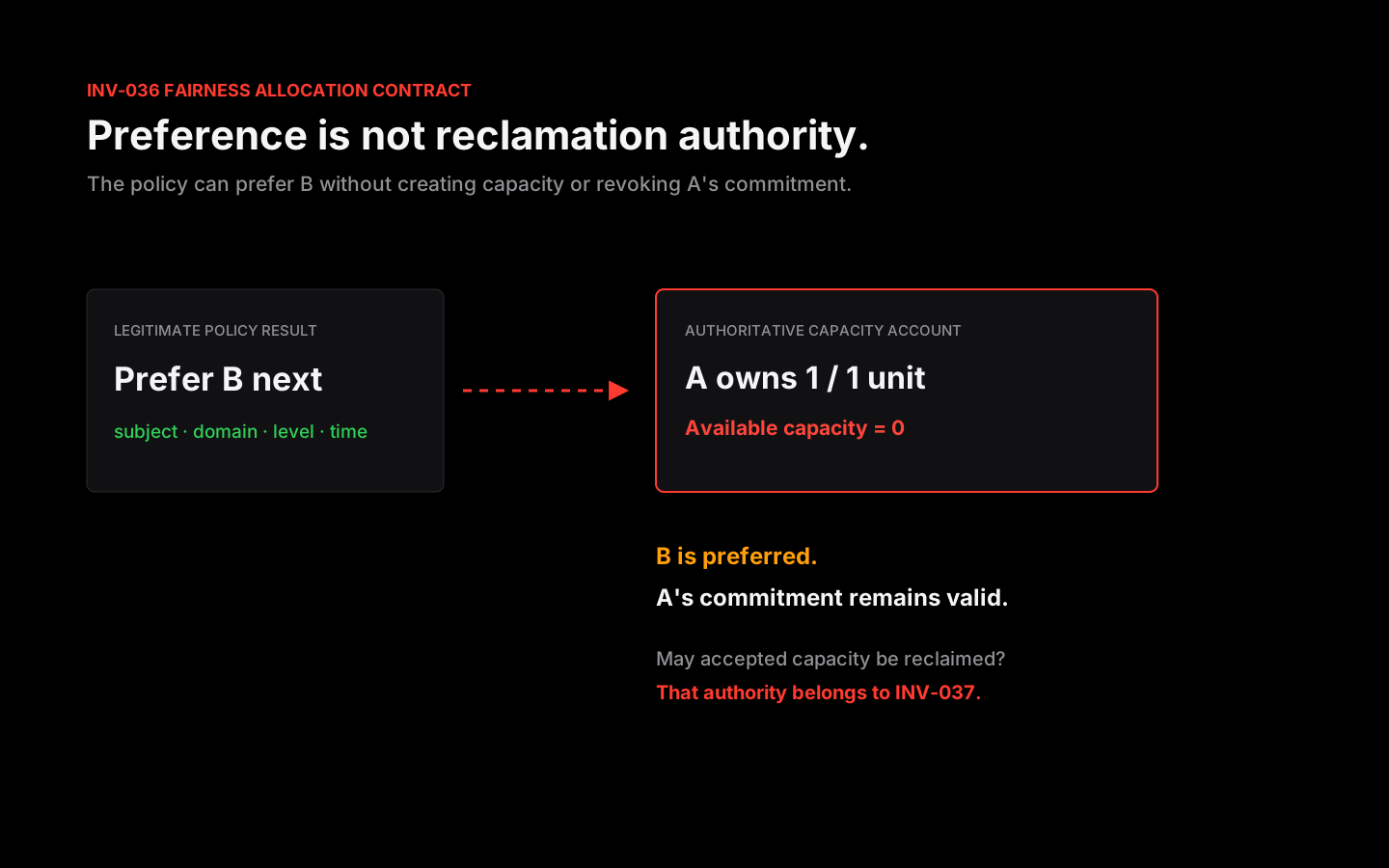
When a legitimate policy preference cannot take effect because capacity is already committed, under what boundary may the platform reclaim that commitment?
Borg and Omega expose fairness as policy over shared finite infrastructure. Kubernetes exposes namespaces, quotas, queue ordering, and priority as concrete policy surfaces. INV-036 extracts the structural comparison boundaries beneath those mechanisms.