Inherited
Claims are legitimate, capacity is finite, and observation is not authoritative state.
Investigation 037 - Distributed Systems Economics
A holds the only unit of a finite capacity account. The commitment is authoritative. A legitimate policy now prefers B, but no capacity is available. Under what boundary, if any, may the platform reclaim A's commitment?
Capacity account
1 unitPreference exists. Authority does not — yet.
Prologue
A already holds the account's one unit. The allocation is accepted and authoritative. B arrives, and the platform determines that B should be preferred. The account still shows zero available capacity. Waiting preserves A's commitment but leaves the preference unsatisfied. Reclaiming the unit satisfies the preference but changes an accepted commitment that previously had authority.
Claims are legitimate, capacity is finite, and observation is not authoritative state.
Let the established preference revoke the less-preferred commitment.
Under what boundary may the platform reclaim capacity that is already committed?
First Principles
A policy ordering. It does not automatically authorize a change to accepted state.
An ownership decision, not a report of current physical consumption.
A change to an existing commitment, not an allocation of already-available capacity.
A snapshot that may already be stale by the time a transition is attempted.
Reclamation decision, authoritative release, and available capacity are not the same fact.
Naive Architecture
A holds the unit. B is preferred. B waits. No authoritative commitment changes merely because a new preference appears. Physical under-use does not shrink A's ownership, and voluntary release is the only event that changes availability.
The Architecture That Almost Worked
Identify the less-preferred commitment, revoke it, and assign the resulting capacity to the preferred claim. The preference finally has a way to take effect.
Nothing in the sequence looks obviously unreasonable. That is exactly why it needs to be tested.
Breaking Our Design
Episode 01 starts from the direct design. Each later episode unlocks only after the preceding discovery creates its boundary.
A policy result and an authoritative state change are treated as though they were the same event.
Assign the unit to A before evaluating a preference.
A commitment ranked by policy comparison is treated as though comparison alone made it reclaimable.
Establish two domains sharing one broader capacity system.
An eligible commitment is reclaimed, yet the released capacity does not satisfy the preferred claim's shape.
Reclaim the eligible commitment within the bounded domain.
A reclamation decision is treated as though it already changed the authoritative capacity account.
Record a reclamation decision without changing authoritative state.
The Turning Point
The Reclamation Contract
An accepted commitment may become subject to reclamation only through authority that is legitimate for that commitment and bounded by an explicit or inherited authority domain.
A policy result may motivate reclamation. It cannot itself revoke an accepted commitment.
A commitment visible to comparison may still lie outside the reclamation authority being exercised.
Released capacity must still satisfy the inherited capacity shape and compatibility model.
A reclamation decision does not, by itself, establish that the authoritative account has recorded a release.
Preference is not reclamation authority. Reclamation authority is not authoritative release. Authoritative release is not guaranteed feasibility.
Only Now: Kubernetes
Kubernetes lets a pending pod's priority motivate the scheduler to evaluate whether evicting lower-priority pods would let it fit. A nominated node records the scheduler's intent; it does not guarantee the pending pod's eventual placement. Non-preempting priority classes exist precisely because priority ordering and reclamation authority are not the same decision.
None of this prescribes a universal priority scale, a victim ranking, or a disruption budget. Those remain policy, and the availability consequences of eviction are deliberately postponed.
A scheduler's preemption evaluation is a concrete realization of the reclamation boundary, not the source of it.
Engineering Reflection
Accepted commitments are intentionally non-revocable, or the cost of displacement exceeds the value of acting. Waiting is the intended behavior.
The system deliberately accepts that an existing commitment may change so a legitimate claim can proceed, and pays for the authority boundaries that make it legitimate.
Preference and authority to change accepted state must stay distinguishable.
Decision, authoritative change, and resulting capacity remain three separate facts.
A reclamation candidate may change before the transition completes.
Released capacity must still pass the inherited capacity model before it satisfies the blocked claim.
Investigation Exercise
State whether A's commitment changes the moment B is preferred, and whether a reclamation decision alone proves capacity is available.
Perform preference, authorization, commitment change, and capacity update as separate, observable transitions.
Record whether a concurrent change can invalidate a reclamation decision made against stale state.
Separate the architectural boundary from the victim-selection policy that chooses which commitment to reclaim.
Bridge to INV-038
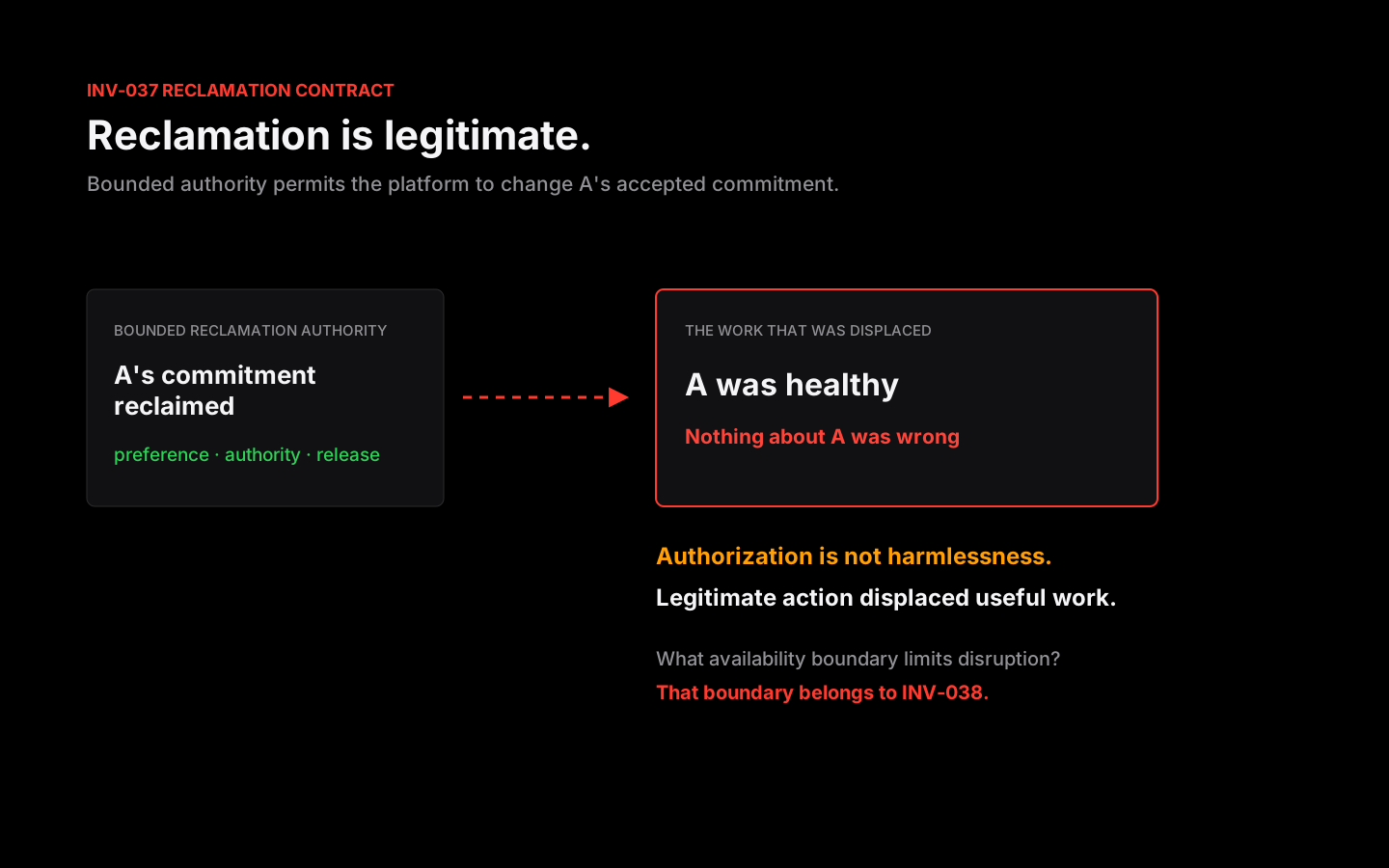
What availability boundary should constrain an intentional displacement of healthy work?
Borg and Omega expose shared-cluster admission, scheduling policy, and resource reclamation among competing workloads. Kubernetes exposes pod priority and preemption as a concrete policy surface. INV-037 extracts the structural authority boundary beneath those mechanisms.